

As a data strategist, you may find yourself feeling very lucky and excited if you are developing a strategy to support a constraints-free and enterprise-wide long-term vision.
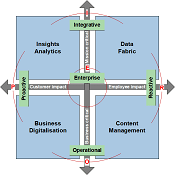
However, the reality is that we are often constrained by limited resources, low data literacy or a resistant culture. This is why I would like to share the structured ‘EPIRO’ approach that I employ to categorise the data strategies below. EPIRO should help you find the best starting point, help accelerate your progress and save you time and energy.
E – Enterprise type. For example, Business Digitalisation driven,
P – Proactive type. For example, Customer Experience driven,
I – Integration type. For example, Business Opportunity driven,
R – Reactive type. For example, Risk and Compliance driven, and
O – Operational type. For example, Content Digitisation driven.
Starting with one type and moving into the next should result in a more effective and efficient implementation over time. Let’s look at the following aspects to describe each of the data strategy types:
- Use Case – The most typical use case,
- Risks – Potential risks and mitigation,
- DG Approach – The most effective Data Governance (DG) approach,
- Information – Reporting and Analytics focus,
- Evolution – Suggestions for moving forward.
Operational type.
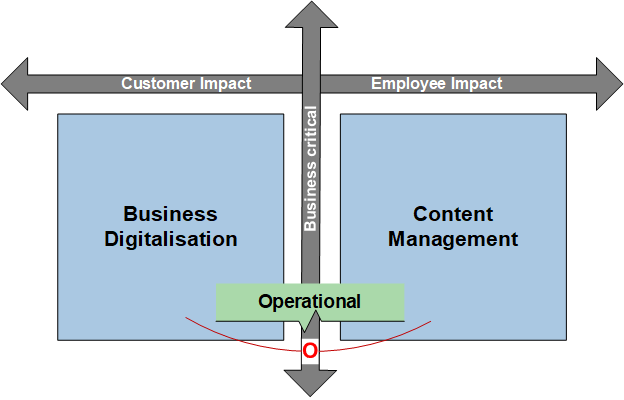
- Use Case. A business-critical data strategy for an organisation that skips a century, let’s say a formerly paper-based business stepping into the digital era. In the digital era, organisations may still be trying to replace network shared servers, the so-called ‘Shared Drives’, with modern content management platforms. The primary focus of the O-Operational strategy will be records and metadata management, which could potentially extend to content management with future plans to take steps toward automation and digitisation.
- Risks. The potential business risks are related to the short-term focus which results in implementation of non-scalable solutions. The digitisation of the paper-based business can be an initial step, which resolves immediate business-critical problems. However, this is also an opportunity to build a foundation for business transformation and enable more strategic goals.
- DG Approach. It is to be expected, that the type of Data Governance here will be passive with the focus on the static (pre-designed) metadata, critical policies and standards. We can establish locally centralised Data Governance with a small set of processes supporting specific business use cases, but only as a tactical initiative on the Enterprise Data Governance Roadmap.
- Information. The Operational Reporting type will most likely be in the centre of the strategy implementations here. Using this opportunity, we could stocktake and categorise reporting requirements, which will help the prioritisation of the Reporting and Analytics initiatives for the following extension of this strategy.
- Evolution. The next step forward for this strategy should be a fast track into the R-Reactive type strategy. With a new capability there is always a new responsibility. There will be a great need in the new processes to ensure the digitised content is compliant. The Enterprise Content Management interoperability capabilities are important to be considered then. This approach will create a need for dynamic metadata supported by an artificial intelligence, which in turn is going to enable a business-critical cross-platform search, intelligent classification, and business process automation.
Reactive type.
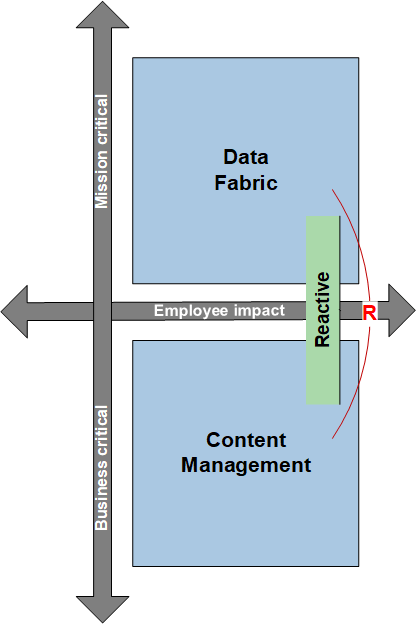
- Use Case. This type of data strategy is special, and it’s not very popular with commercial organisations. The development of a reactive data strategy is often motivated by IT reform or by a compliance and regulation driven transformation due to a change in obligations and requirements. Expert with an industry and business knowledge may be required for a successful implementation. The biggest impact in this scenario will be on personnel.
- Risks. Enterprise Data Architecture is a key player in this arena as we need to be proactive and balance out this non-data-driven strategy. This approach will ensure agile data management capabilities, which in turn enable flexibility and efficiency during the next round of changes. We will achieve this by building dynamic catalogues, providing transparency with the help of a data lineage, introducing governance processes for the critical business rules, and by creating archiving and retention policies.
- DG Approach. All the data governance processes for R-Reactive type are initially aimed at data quality and they often include disparate data sources. This requires a centralised top-down approach to the data governance in order to support well architected data management. The enterprise data quality practice will require new data stewardship roles. However, this does not mean that the data governance has to be reactive and passive. We set a benchmark by building quality-measured information products for an organisation that will transform and mature.
- Information. Standard Reporting is an important reporting type for an organisation’s external obligations, as well as for monitoring performance internally. These reports commonly use the highest quality information that an organisation is capable of. If feasible, having one main reporting platform for all Standard reporting would be the best approach. Innovative business improvements can be enabled by Analytics, which is also a good way to support proactive risk management. Often Analytics require different technology for the intelligent decision support.
- Evolution. Any extension into the I-Integration type strategy would be most effective moving forward. This would be the most logical next move as we would have built a trusted source of the business core data, the data governance pattern and expertise, and all the security and data protection smarts. If a solid data architecture has been defined through this R-Reactive type strategy, it will help to support the growing business appetite for advanced analytics and business growth.
Integration type.
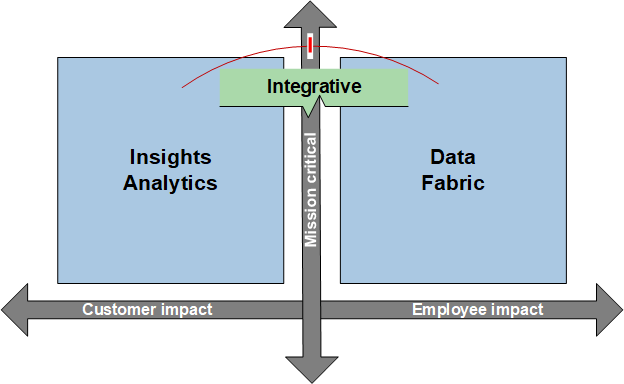
- Use Case. This area represents a mission critical Data and Analytics Strategy impacting both personnel and the customer. It may be critical to a transformation program that is driven by a merger of multiple businesses, or by an internal business integration for growth opportunities. Having a clear business goal, like a specific cross-selling opportunity, can be a driver for change.
- Risk. A lot is at stake if an effective collaboration between multiple business unit operations and the IT team or teams are not established. To enable such an important collaboration, the strategy needs to start with the business outcomes and value propositions.
- DG Approach. The Data Governance framework needs to be designed with a de-centralised approach, mainly driven by a business strategy or strategies. This will mean: new roles and training, information self-service and new tools, conflicting priorities and negotiations, and single or multiple business units with control over the governance execution.
- Information. This strategy should introduce enterprise reporting and analytics tools to respond to the program’s requirements for information. In addition to the traditional Business Intelligence, an interactive reporting platform is an opportunity to establish a foundation. With business trust in the information that becomes available and accessible, the predictive analytics tools will be in demand because there will be various business hypotheses that will need to be tested.
- Evolution. Architecture artefacts like Technical Reference Architecture and processes like Information Lifecycle Management will help to identify important gaps in the data enablers for the business and technology. When these gaps and deficits are made transparent, it can enable thoughtful and effective prioritisation. Hence, we achieve complete alignment to the business strategy. This is how the Data and Analytics Strategy can become an important part of the business strategy.
Proactive type.
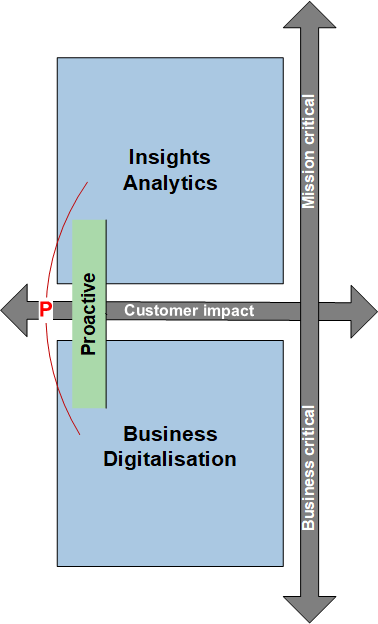
- Use Case. With this approach, the biggest impact will be on customers, or stakeholders if an organisation is not a direct service provider. The program of work can be driven either by business ambition for an exceptional customer experience, or by stakeholder goals and requirements. The complexity will depend on what the most important priorities are for the business outcomes. For example, if the priority is unified commerce for the customer, we will need a Single View Of Customer to be in place. Similarly, if the priority is effortless compliance for the stakeholder, we will need quality data to be available and accessible.
- Risk. The most important focus areas of this strategy can be summarised into two high level capabilities: processing the information and presenting the information. This might sound easy, however, to satisfy business ambitions these simple words can incorporate modern enablers, such as data fabric, inbuilt data quality processes, data virtualisation, machine learning, artificial intelligence, dynamic catalogues, automated data protection, smart ontologies, and real time information.
- DG Approach. The Data Governance becomes more sophisticated in the P-Proactive data and analytics strategy. In addition to the data management questions, Analytics and Machine Learning come into play. Even though these capabilities could be local to a business unit, the impact will be on the whole enterprise. This is why the framework design should consider a transition towards a good balance between the centralised and decentralised approach. It may be that some existing data governance functions and roles can be centralised, maybe some other functions will stay apart: whatever works for the main business outcomes that are committed to in the strategy.
- Information. Automated advanced analytics will require new inbuilt capabilities, and will introduce a new way of working when IP and knowledge is the main asset, and not software or capitalised information management services development. These information products may have a short lifecycle, but they can have a strong impact on the business.
- Evolution. End-to-end transparency, discoverable analytical outcomes, and customer impact are important capabilities to analyse and find the right balance of agility and control. An organisation that invests in the advanced analytics needs to be ready to act on the findings. When the culture is transformed, the E-Enterprise type strategy will become possible, then ready to be disruptive.
Enterprise type.
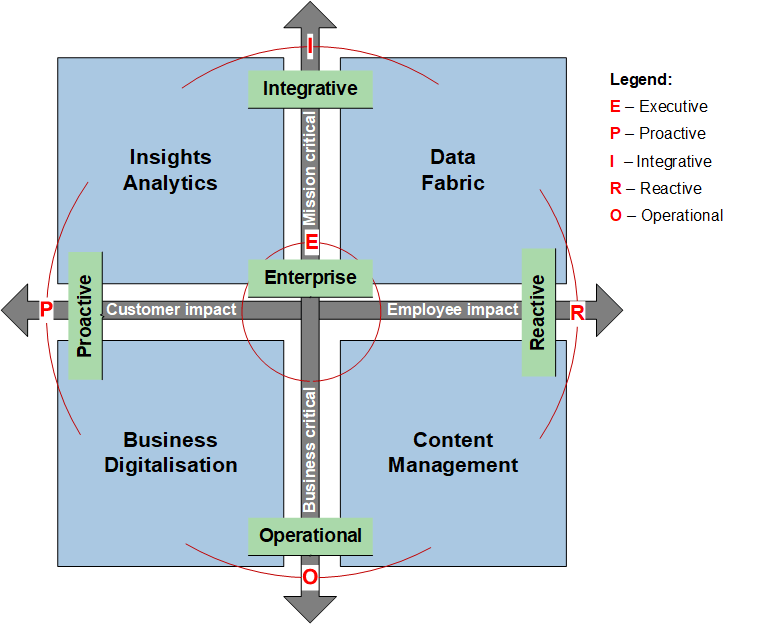
- Use Case. The most complete and exciting strategy is in the centre of the framework diagram. We focus on the long-term business goals and totally infuse the business strategy with disruptive thinking and answers to the business needs. Starting at a high strategic level, we will need to drill down into more detail to be able to streamline and support all those four domains above but remain balanced. The best scenario for the E-Enterprise type strategy realisation is when the strategy is implemented as a part of a large-scale Digital Transformation.
- Risk. The evolvement of the Data and Analytics Strategy needs to be an agile process, where the strategy’s core non-negotiable direction creates room for deviations and tactical steps. Any deviation from the course is assessed against the set direction and this is how the strategy stays relevant to the environment and empirically-based. This data and analytics strategy creation and implementation will require strong drive and executive support. This is the most difficult journey for Data, however it may be the most desirable and possibly even the most necessary approach in the modern accelerating world.
- DG Approach. Data Governance would also need full executive support, and it would be run as a long term program with a dedicated budget to support the roadmap. You need to develop an Enterprise-wide Data Governance framework, however the implementation of it would need to start with small steps. In some cases, we might be able to start multiple Proof of Concept initiatives in several functional areas, whilst clearly articulating the next steps and how we get to the target state. For example, within a function responsible for the Digital Transformation program’s data configurations, a data governance working group can be established as a proof of concept initiative to test the new ways of working for the data quality practice. That organisation can still connect and integrate to the enterprise data governance, if exists. Another area that is critical for digital transformations is analytics, machine learning and artificial intelligence. This is where a second DG working group could bring additional value and help this area to be frictionless and evolutionary as business appetite grows for data products and catalogues, algorithms, and so on.
- Information. If this strategy is successful, everyone in the enterprise will become a part of an Analytics Community. Data storages, integration platforms, and data warehousing solutions are the focus no more. The main focus is on the processes: to allow agility of onboarding; to enable intelligent data protection; to connect the tools of the end user’s choice; to have only appropriate security; to discover new relevant data sources and to also make them automatically linkable to the existing data.
- Evolution. Digitalisation has become a much stronger case than Data, however Data is a fundamental pillar, especially for Digitalisation. This approach will present many opportunities to cover all critical components of the Data and Analytics Strategy, which cannot be avoided at the enterprise level. We are talking about the data and analytics governance, processes and capabilities, new operating models, new community-based culture, modern tools and disposable information products. Perhaps, the CDO (Chief Digital Officer) will soon be renamed to CDO (Chief Data Officer)!
Copyright © NeatenMyData


Great idea and very clear presentation. Thanks!
LikeLiked by 1 person
Very interesting article, well- written and structured, thank you!
LikeLiked by 1 person
Good insight. I liked and quickly relate to the “Enterprise type” view with what we generally deal in a large enterprise like a Big Bank. And it’s interesting to see the approach which can be used in other industries with varying digital presence and data maturity of an organisation. 🙂 Thanks Janna.
LikeLiked by 1 person
As usual this is perfectly explained and very easy to understand.
LikeLiked by 1 person
Thank you.
LikeLike
Very interesting , good job and thanks for sharing such a good blog.
Data warehousing software in Saudi Arabia
Data warehousing systems in Saudi Arabia
LikeLiked by 1 person
Clear and concise Janna. Interestingly in the Banking & Financial Markets business model -Risk Analytics for Risk Management is a core capability and key proactive operational requirement in managing the business, where as compliance is clearly reactive, differentiating data strategies for the two is key. Proactive data strategies around customer analytics has also enabled many tier 1 banks around the world to build a serious competitive edge.
LikeLiked by 1 person
Thank you
LikeLike